Flat Clearance Knightsbridge — Recycling and Sustainability
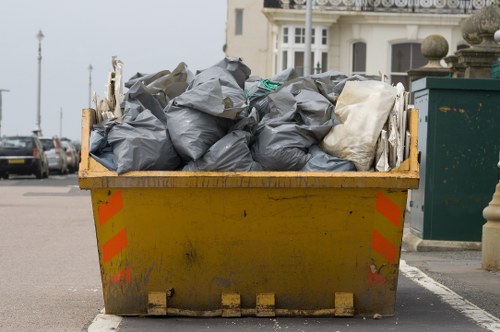
Welcome to our dedicated sustainability page for Flat Clearance Knightsbridge. We describe a practical, eco-conscious approach to clearing flats in Knightsbridge and neighbouring areas. Our services focus on eco-friendly waste disposal, maximising reuse and minimising landfill. Whether you're commissioning a full flat-clearance in Knightsbridge or a smaller apartment clear-out, our processes prioritise salvage, donation and certified recycling to reduce environmental impact.Our commitment blends local knowledge with measurable goals: we set a recycling and recovery benchmark that aligns with borough ambitions and London's broader waste reduction plans. We explain our targets, show how we work with local transfer stations and charities, and outline the low-carbon vans and route optimisation we use to keep emissions low. The following sections detail our operational commitments and how they make flat removal in Knightsbridge more sustainable.
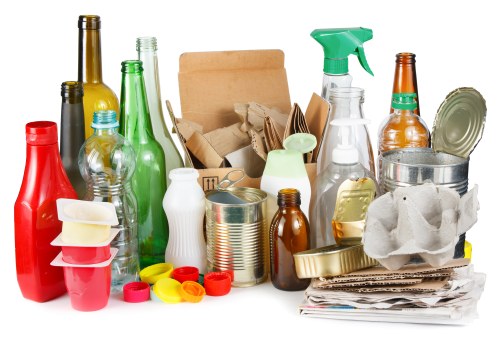 Recycling percentage target: we aim to recover and recycle 75% of all materials from each clearance by 2028. This target covers re-use, donation to charities, material recycling (paper, card, glass, metals, wood, textiles), and safe processing of hazardous items and WEEE (Waste Electrical and Electronic Equipment). By setting a clear percentage goal, our Knightsbridge flat-clearance teams measure diversion from landfill on every job and publish periodic aggregated performance summaries.
Local transfer stations and waste hubs
We coordinate collections through authorised transfer stations and local depots serving the Royal Borough of Kensington and Chelsea and adjacent boroughs such as Kensington, Westminster and Hammersmith & Fulham. Items that cannot be reused on site are delivered to certified local transfer stations and material recovery facilities that separate streams for:- dry recyclables (paper, cardboard, rigid plastics, cans),
- food and garden waste for composting where applicable,
- bulky items and metals for specialist processing,
- WEEE and hazardous materials to accredited recyclers.
This localised routing reduces haulage distances and supports borough-level waste separation policies, which typically require source-separated collections for dry recycling, food waste and textiles. We work to ensure that material flows respect the boroughs' approaches to waste separation and reuse.
Partnerships with charities and social enterprises
We prioritise partnerships with local charities and social enterprises to ensure usable furniture, clothing and household goods find a new life. Typical partners include charities that accept furniture and household items for resale or community reuse projects. Our reuse pathway helps extend product life and supports local social programs, reducing waste while supporting those in need.Key elements of our partnership model include:
- Pre-collection triage: identifying items suitable for donation during on-site assessments.
- Direct handover or controlled transfer to charity partners to ensure integrity of donations.
- Tracking and reporting the volume and estimated reuse value of items donated.
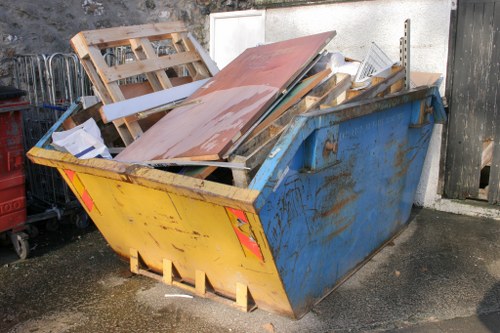 Alongside well-known charities we also collaborate with local furniture re-use social enterprises, mattress recyclers and specialist textile recyclers. These partnerships reduce the amount of reusable material entering the waste stream from flat removal jobs in Knightsbridge and nearby neighborhoods.
Our fleet consists of low-emission vehicles including electric vans and Euro 6-compliant low-emission diesel vans for longer runs. We actively deploy low-carbon vans for inner-city pickups and use hybrid vehicles where charging infrastructure or operational range requires it. Route planning software and consolidated pickups reduce empty runs and further cut emissions for every flat clearance in Knightsbridge.
We also invest in driver training for eco-driving, load optimisation techniques and regular vehicle maintenance to keep fuel consumption and emissions to a minimum. The cumulative effect of efficient routing and low-carbon vans is a measurable reduction in CO2 per job compared to conventional clearance operations.
Operational transparency is important: for larger projects we provide clients with a recycling breakdown showing percentage diverted, items donated and materials recycled. This data supports corporate sustainability reporting and demonstrates our contribution toward local recycling targets.
To ensure a sustainable rubbish area and responsible disposal, our teams segregate loads on site wherever possible. Segregation reduces contamination, improves recycling yield and supports local councils’ waste separation schemes. Materials such as metals, timber, inert rubble, textiles and electricals are separated and routed to appropriate processing streams to maximise recovery.
Processes we use include careful on-site sorting, consolidation at transfer hubs, specialist recycling for WEEE and mattresses, and donation routing for good-condition items. Our approach reduces the need for landfill and supports circular-economy practices in urban flat clearance.
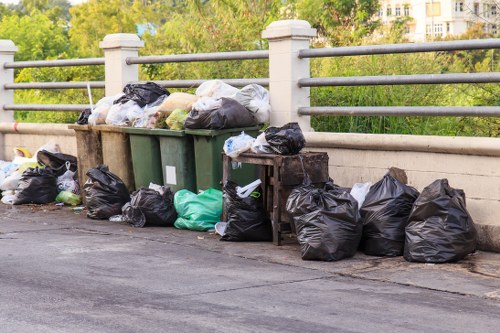 We also work with borough recycling teams and community groups to pilot collection days for problematic materials, such as batteries and small electricals, providing an alternative to placing these items in residual waste bins.
 In summary, our flat-clearance services in Knightsbridge combine practical waste handling with ambitious sustainability targets. By aiming for a 75% recycling rate, collaborating with nearby transfer stations and charity partners, and operating low-carbon vans, we create an end-to-end process focused on reuse and minimal environmental impact. For anyone seeking responsible, eco-friendly flat clearance in Knightsbridge or nearby areas, our model shows how measured targets and local collaboration deliver better outcomes for both communities and the environment.
Our pledge: continue improving diversion rates, expand charity partnerships, upgrade fleet technology and support borough-level waste separation efforts. Together, these steps ensure that flat clearance in Knightsbridge is both efficient and genuinely sustainable.
Commitment to continuous improvement: we review performance annually, publish aggregated diversion figures and update operational practices to meet evolving environmental standards — always focusing on reducing waste, maximising reuse and lowering carbon emissions in every clearance.